Focus on carbon equipment
Focus on carbon equipment


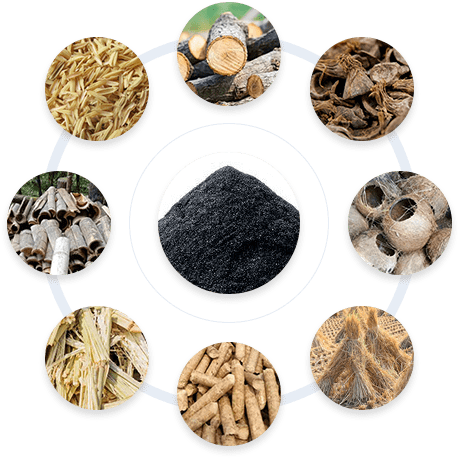
In today's world where resources are increasingly precious, the efficient utilization of every raw material has become crucial for industrial development. The advent of the peanut shell carbonization machine is a brilliant response to this issue, transforming what appears to be a low-value agricultural byproduct into a high-value industrial product.

The core value of this machine lies in its highly efficient conversion capability. It can continuously and stably process large quantities of peanut shells into biochar with a fixed composition and excellent quality. This standardized output allows biochar to enter the market as a reliable industrial raw material or commodity, creating a new economic growth point.
The resulting industrial chain is vast. The produced biochar can be used as environmentally friendly fuel in industries such as metallurgy and heating; it can be used as an adsorbent to purify water and air; and it can serve as a high-quality base for producing activated carbon, with enormous potential for further processing.
Therefore, the peanut shell carbonization machine is not merely a piece of technical equipment, but an industrial engine. It has activated a "second economy" outside of the main peanut industry, turning a waste disposal cost center into a profit center, bringing considerable economic benefits and employment opportunities to the production area, and achieving a win-win situation for both the environment and the economy.
We are delighted to announce that Dingli Group will be participating in the upcoming PalmEX to be held in Jakarta, Indonesia.
A continuous biomass carbonization plant is an innovative solution for transforming agricultural residues and forestry waste into renewable energy products. By utilizing pyrolysis technology, the plant converts organic materials into biochar, combustible
Agricultural waste recycling has become a critical component of modern environmental management. A biomass continuous carbonization machine transforms crop residues into valuable biochar, providing a sustainable alternative to open burning and landfill di
A continuous biochar production line combining carbonization and pyrolysis technology represents a modern approach to biomass processing. Continuous carbonization equipment functions as the core unit within this system, ensuring stable throughput and cons