Focus on carbon equipment
Focus on carbon equipment



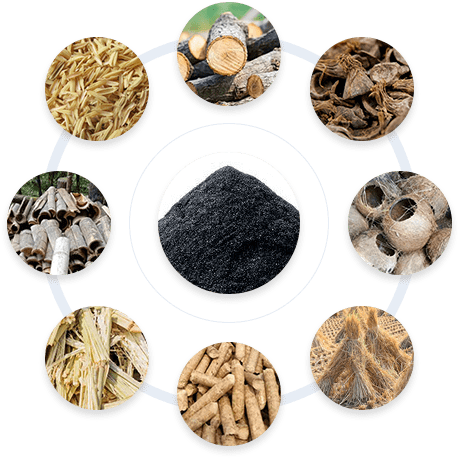
Dingli biomass charcoal briquetting production line is to crush raw materials such as coconut shell, palm shell, rice husk, wood chips, etc. into granules within 10mm through a crusher, and put them into a carbonization furnace for carbonization and carbon powder after being dried by a dryer. Briquetting machine A machine for briquetting. The charcoal produced by the biomass charcoal machine has high density, small size and good flammability, which can be used as barbecue charcoal.

Dingli biomass charcoal briquetting production line includes: pulverizer, dryer, carbonization furnace, briquetting machine. Can be adjusted according to customer requirements. Dingli Group's coconut shell carbonized briquette production line can be divided into different models according to the daily processing capacity. Including the production line of coconut shell charcoal machine with a daily output of 1 ton (an annual output of 300 tons of coconut shell charcoal machine production line); the production line of a coconut shell charcoal machine with a daily output of 3 tons; the production line of a coconut shell charcoal machine with a daily output of 5 tons! Can be customized according to customer requirements.
Dingli Group is a professional supplier of dryers and carbonized briquetting equipment, supporting equipment output customization, site customization, and free installation. Welcome to consult the equipment details.
With the growing global demand for high-quality activated carbon in water treatment, air purification, food processing, and industrial applications, coconut shells have become an ideal raw material due to their high carbon content, low ash content, and ex
Dingli Group was recently invited to attend the 3rd International Conference on Biochar Research and Application and the 2026 IBI Biochar World Congress. There, the company engaged with global experts, scholars, and industry representatives to explore new
The Hardwood Carbonization Furnace is an advanced solution designed for converting hardwood logs, branches, wood chips, and other woody biomass materials into high-quality charcoal through an efficient carbonization process.
From August 7 to 10, 2026, a major global event in the biochar field—the 3rd International Conference on Biochar Research and Application and the 2026 IBI Biochar World Congress—will be grandly held in Zhengzhou, China.